Some provider links may be affiliate links. We may receive compensation. Read our editorial approach and disclosure.
Platinum and palladium are both precious platinum-group metals (PGMs) used heavily in auto catalytic converters and industry. They look similar and share a family, but they differ in supply, demand drivers, price history, and investment characteristics. This is general information, not investment advice.
What They Are
Platinum and palladium belong to the platinum-group metals — rare, dense, corrosion-resistant metals prized for their catalytic properties. Both are far rarer than gold and are mined in small annual volumes, which makes their prices sensitive to supply shocks. For a refresher on units and weights, see our troy ounce explained guide.
Demand Drivers
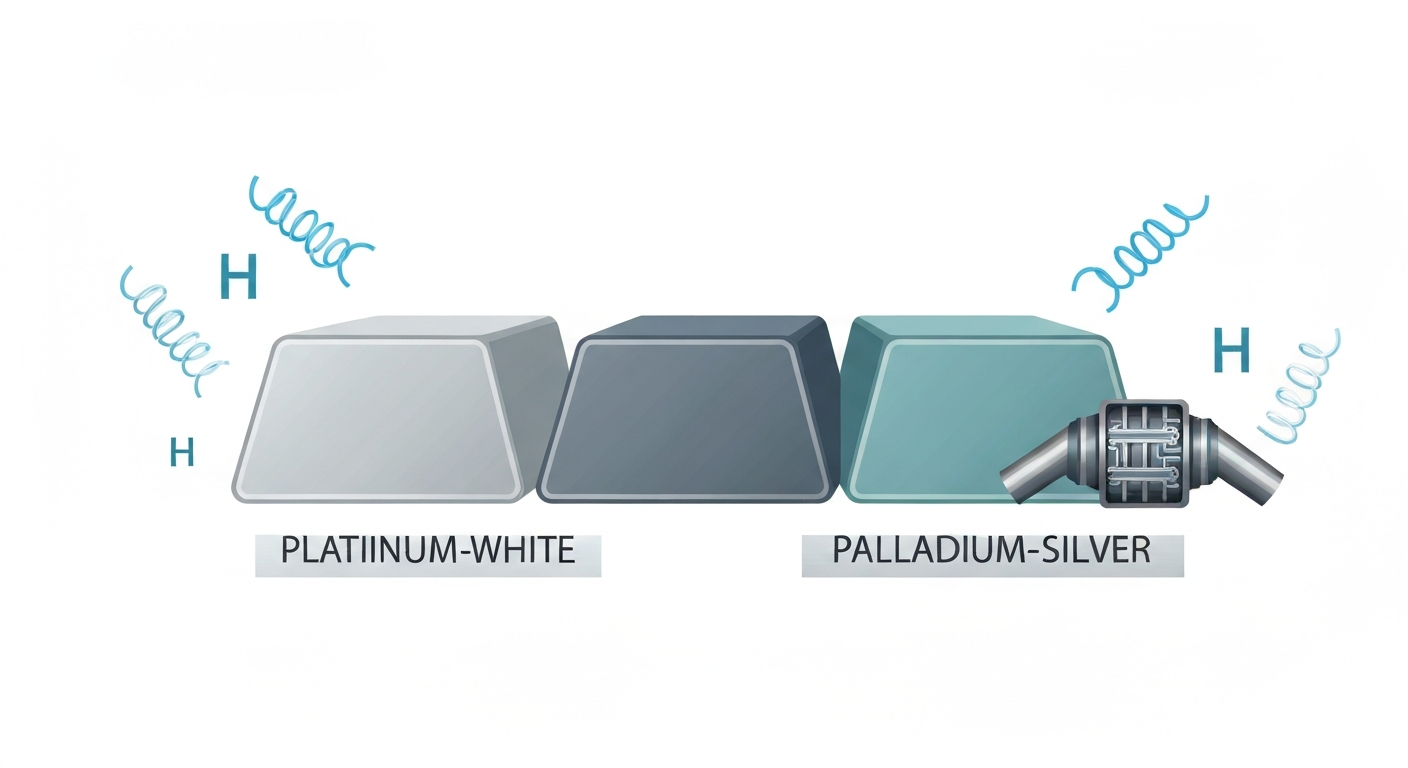
The biggest use for both is autocatalysts — the converters that clean vehicle exhaust. Historically, palladium dominated gasoline engines while platinum was favored in diesel. Because they can substitute for each other in some catalyst formulations, high palladium prices have pushed manufacturers to shift back toward platinum. Platinum also has meaningful jewellery demand and a growing role in hydrogen fuel cells and electrolysers; palladium demand is more concentrated in autocatalysts and electronics.
Supply
Supply is highly concentrated: South Africa dominates platinum, and Russia and South Africa together dominate palladium. Much of it is mined as a by-product of other metals, so output doesn’t respond quickly to price. That concentration creates real supply risk — mine disruptions or sanctions can move prices sharply.
Price History & Relationship
For decades platinum traded above palladium. That flipped in recent years when tight supply and strong gasoline-engine demand sent palladium above platinum, at times dramatically. Because the two can substitute in catalysts, many investors watch the ratio for potential mean reversion — the idea that an extreme gap tends to narrow over time as substitution and new supply respond. Prices and this relationship change, so treat any ratio as a snapshot, not a rule.
Investing — and the EV/Hydrogen Angle
You can gain exposure through physical bars and coins, ETFs, or mining shares — each with different premiums, storage, and risk. The big long-term question is the EV transition: fully electric cars use no catalytic converter, which threatens autocatalyst demand for both metals over time. Platinum has a potential offset in hydrogen (fuel cells and green-hydrogen electrolysers use platinum), giving it a cleaner long-term demand story than palladium, which is more tied to the internal-combustion engine. For where these fit alongside other metals, see our palladium investment guide and silver bullion guide.
| Factor | Platinum | Palladium |
|---|---|---|
| Main demand | Diesel autocatalysts, jewellery, hydrogen | Gasoline autocatalysts, electronics |
| Top supply | South Africa | Russia & South Africa |
| EV transition | Offset by hydrogen upside | More exposed |
| Recent price | Historically lower recently | Spiked above platinum |
Frequently Asked Questions
Is platinum or palladium more valuable?
It has changed over time. Platinum was long the pricier metal; palladium overtook it in recent years due to tight supply. Their relative price shifts with supply and auto demand.
Can platinum and palladium replace each other?
Partly — in catalytic converters, manufacturers can substitute one for the other within limits, which links their prices and drives long-term rebalancing.
Which is better for the long term?
Platinum has a broader demand base (jewellery + hydrogen) that may cushion the EV transition, while palladium is more tied to gasoline engines. Neither is guaranteed; diversify and do your own research.
Bottom line: platinum and palladium share a family and a main use, but differ in supply, price history, and long-term demand — platinum leans on hydrogen upside, palladium on the gasoline engine. Not investment advice; prices change.