Some provider links may be affiliate links. We may receive compensation. Read our editorial approach and disclosure.
Quantitative easing (QE) is the most consequential monetary tool of the modern era — and one of the biggest forces behind gold’s long-term rise. Yet most people only half-understand it. Here’s what QE actually is, how it works step by step, and why it matters so much for gold and silver investors.
What Is Quantitative Easing?
QE is when a central bank — the Federal Reserve, ECB, Bank of England, Bank of Japan — creates new money electronically and uses it to buy government bonds and other assets from banks and institutions. The aim is to push money into the financial system, lower long-term interest rates, and stimulate borrowing and spending. It’s an unconventional tool, deployed when normal policy (cutting short-term rates) is exhausted because rates are already near zero.
How QE Works, Step by Step
- The central bank buys bonds on the open market, creating reserves out of thin air to pay for them.
- Banks end up flush with reserves instead of bonds — cash they’re encouraged to lend.
- More lending + more money in circulation increases the money supply.
- Interest rates fall because there’s more money available to lend, making borrowing cheaper and (in theory) reviving the economy.
The opposite process is quantitative tightening (QT) — letting bonds mature without reinvesting, which drains liquidity and tends to raise real yields.
A Short History of QE
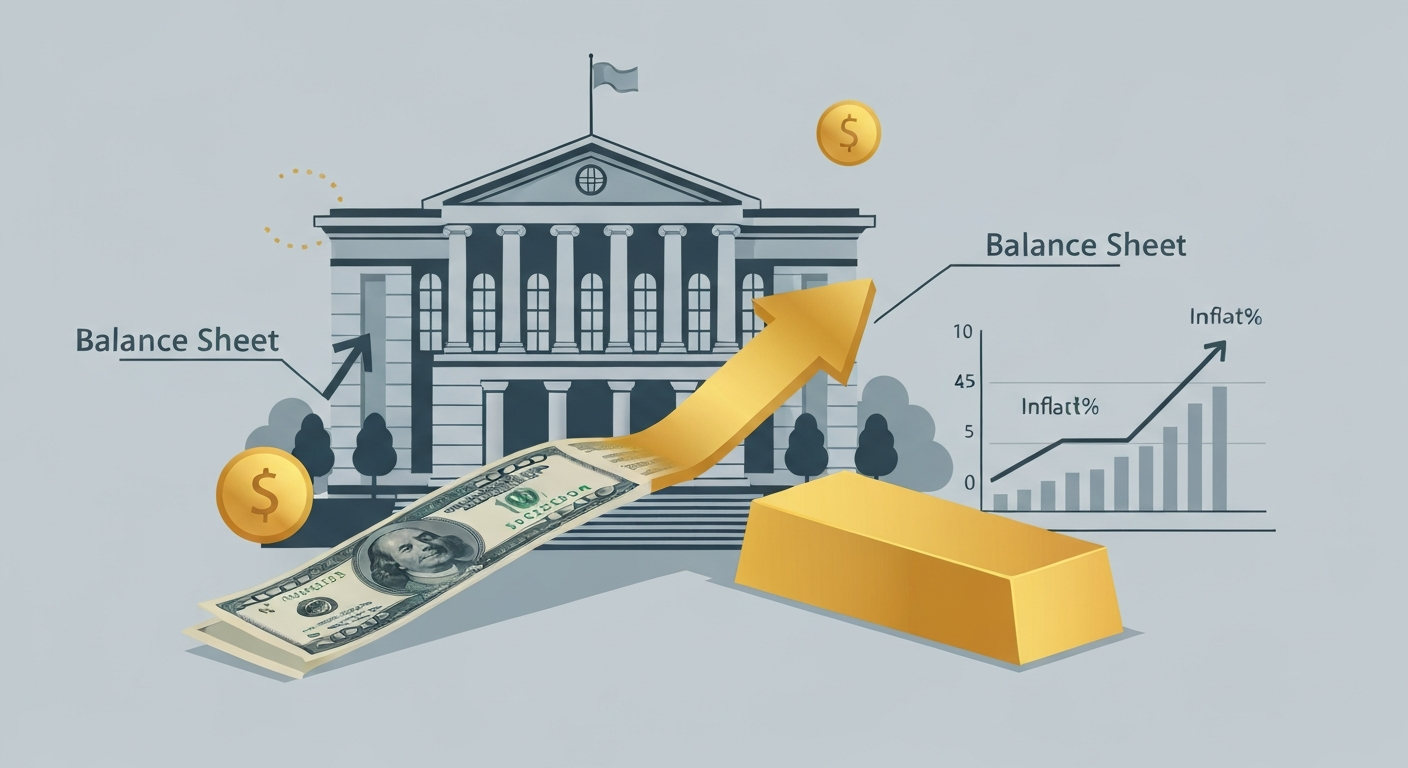
The US ran three post-crisis rounds: QE1 (Dec 2008–Mar 2010), QE2 (Nov 2010–Jun 2011) and the open-ended QE3 (Sep 2012–Oct 2014). Then came the 2020 COVID response, when the Fed pledged effectively unlimited purchases. Across these programs the Fed’s balance sheet ballooned from roughly $800–900 billion before 2008 to well over $4.5 trillion. In 2022, facing 40-year-high inflation, the Fed reversed into QT.
Why QE Matters for Gold
QE creates the exact conditions in which gold has historically thrived:
- Currency devaluation. Every new dollar dilutes the purchasing power of existing dollars; gold, whose supply grows only ~1.5% a year through mining, is the mathematical counterweight.
- Negative real interest rates. Real rates = rates minus inflation. QE lowers rates and lifts inflation expectations, cutting the opportunity cost of holding non-yielding gold.
- Inflation hedging & falling fiat confidence. Large-scale money creation raises long-run inflation risk and can dent confidence in the currency — both bullish for gold.
- Wealth effect. QE lifts asset prices broadly, and some of that wealth rotates into gold as diversification.
The historical record is striking: gold rose ~47% during QE1, and major rallies of the past two decades — 2008–11 and the 2020 surge — coincided with QE programs.
The Important Nuance
QE isn’t a simple “money printing → gold up” switch. There’s no strong short-term statistical link; the effects play out over the long run. In fact, gold fell after QE2 ended and during parts of QE3, because restored confidence in the economy reduced safe-haven demand and lifted stocks instead. The takeaways for investors: gold often reprices ahead of formal announcements (don’t wait for the press release), and the low-real-rate environment QE creates can persist for years after a program ends. Note too that QT tends to be a headwind for gold — but a weaker one in reverse, since markets also fear the economic damage tightening can cause.
The Risks of QE
The primary risk is inflation — sometimes delayed, as in 2009–15 when banks parked reserves rather than lending, but historically money-supply growth eventually feeds into prices. The deeper risk is to central-bank credibility: fiat currency depends on confidence in prudent monetary management, and aggressive, repeated QE strains that confidence — which is exactly why many investors hold gold as insurance.
For where this leaves prices, see our 2026 silver outlook and our explainer on the gold-silver ratio.
Frequently Asked Questions
Is QE the same as printing money?
Effectively yes — the central bank creates new money electronically (as bank reserves) to buy assets, even though physical banknotes aren’t printed.
Does gold always rise during QE?
No. Long-term QE conditions favour gold, but short-term moves depend on confidence, real rates and inflation expectations — gold fell during parts of QE3.
What’s the difference between QE and QT?
QE injects liquidity by buying bonds (bullish backdrop for gold); QT withdraws it by letting bonds mature (a headwind).
Why does QE push real interest rates negative?
It lowers nominal rates while raising inflation expectations — and when inflation exceeds rates, real rates turn negative, which historically benefits gold.
This article is for information only and is not financial advice. Consult a licensed advisor before investing.